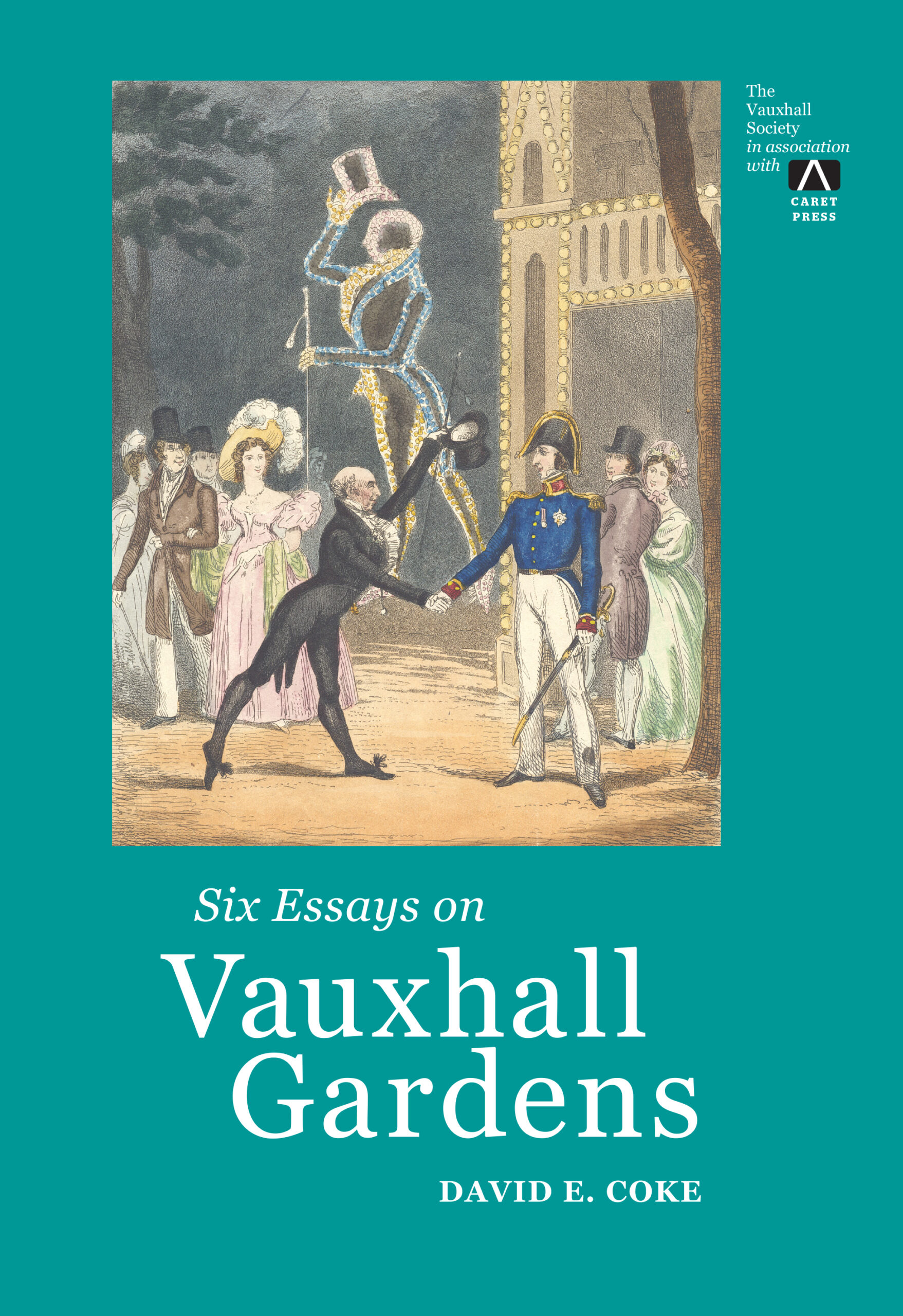

by David E. Coke, Vauxhall History consultant editor
Although machinery to project images had been in use for two centuries, classic Magic Lantern shows gained huge popularity from the 1870s and ‘8Os. The lanterns themselves became more affordable, more mobile, and more technologically advanced, allowing travelling ‘Professors’ to take their lanterns to parish halls, schools and even private homes for professional slide shows. The display of picture series, with titles such as ‘The Beauties of the Lake District’, or ‘The Historic Sites of London’ were accompanied by a running commentary, which could be educational, entertaining, or informative, or all three. The two individual slides discussed here come from different series, but both show features of south London in the recent past.
Online auction sites can be amazing and exciting places, not just for buying and selling, but for research and discovery too. Items of a rich historical interest turn up out of the blue, often items that would be hard to find anywhere else. Such a find turned up one day in the autumn of 2023, when a vendor in Exeter listed two extraordinary photographs of well-known features of the Vauxhall townscape.
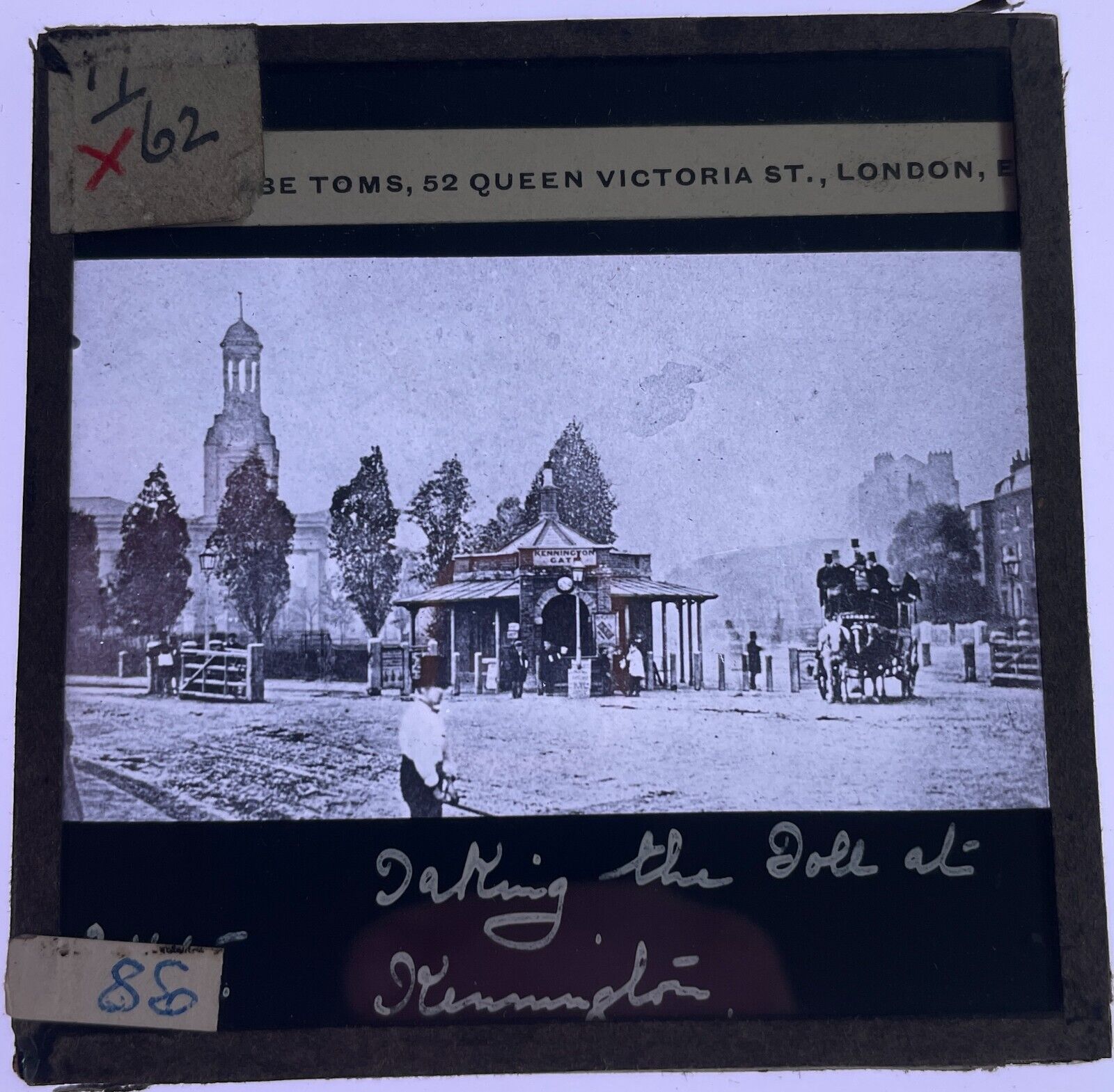
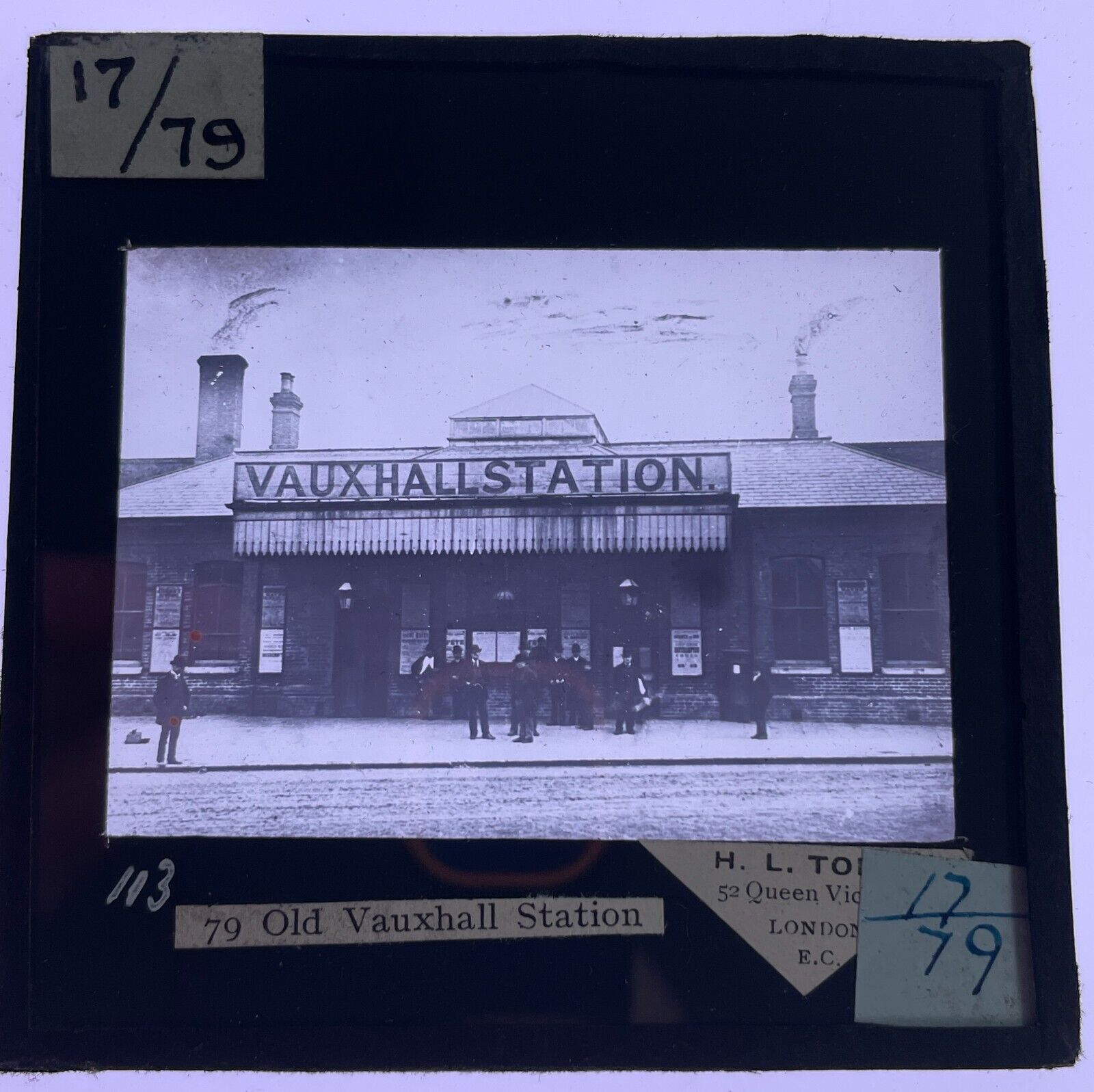
The two photographs [Figs 1 & 2] are in the form of magic-lantern slides made in the 1890s by Henry Joseph Luscombe Toms and his employees in Queen Victoria Street (London EC4), where many such slides, mostly in numbered sets, were made and sold or hired. Toms (1870–1935) set up his slide manufacturing business aged just 23 in 1893, having taken over the existing company of Ebenezer Marshall (who had been in business since 1870); his slides would have been used to produce slide-shows by well-off middle-class families at home, or by travelling entertainers, who would project them in public halls with a commentary, called a ‘lantern reading’, before the days of cinema.
Henry Luscombe Toms, who called himself an ‘optical lantern dealer’ in the 1901 census, and ‘Entertainment Contractor’ ten years later, went on to invent and patent ‘An Improved Adjustable Lime-light Burner for Magic Lanterns and similar purposes’ in 1893. In the 1920s his company was producing advertising films and animations, as well as short sing-along films, notably in his ‘Community Song Series’ of 1927.
Although our two slides look as though they depict contemporary scenes, and that Toms is selling views of the London he knew, all is not entirely as it seems. Toms was not himself a photographer, and he appears not to have employed one, so he had to duplicate existing photographs.
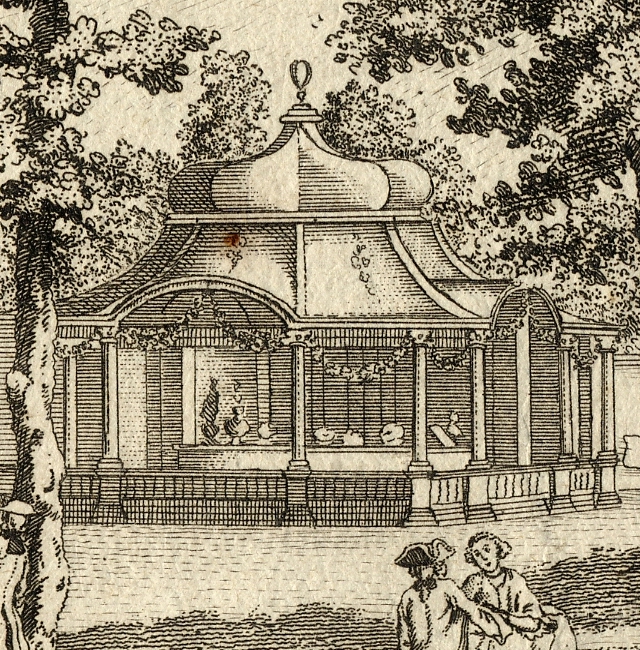
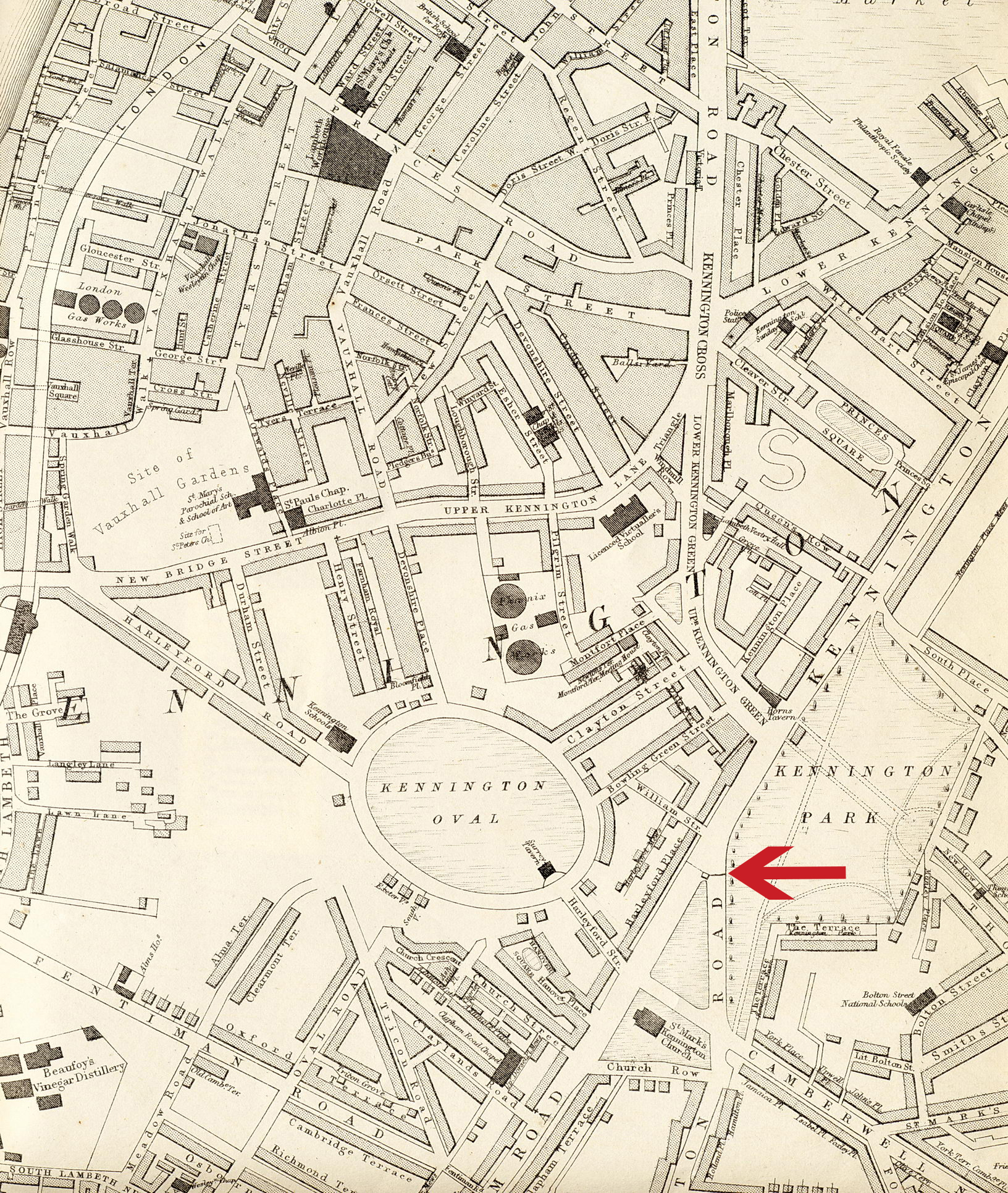
The first of the two slides is titled ‘Taking the Tolls at Kennington’; it shows the Kennington Toll-gate or Turnpike, an octagonal (or possibly hexagonal) brick building with a conical roof topped by a chimney, built sometime before 1790. This shape, coincidentally or not, recalls the 1742 building at nearby Vauxhall Gardens called the Turkish Tent [Fig.3], which may have inspired it. Behind the toll-house, to the left, partly obscured by trees, is St Mark’s church, built in 1824 on the site of the old gallows corner on Kennington Common; on the right, in front of the row of houses called Harleyford Place, is a coach drawn by two horses from the Clapham Road, about to drive north into London, on Kennington Park Road, having paid the toll [Fig 4].
In the photograph, the scene looks tranquil and almost rural, but this road would always have been a busy thoroughfare for traffic from south London to the southern home counties, towards Winchester, Portsmouth and Southampton, so the photographer, standing near the junction of Kennington Park Road and the Brixton Road has captured a rare quiet and dust-free moment. Early photographers would frequently imitate the work of ‘orthodox’ artists, and this image certainly evokes the popular coaching scenes of painters such as James Pollard (1792–1867) and Henry Alken (1785–1851).
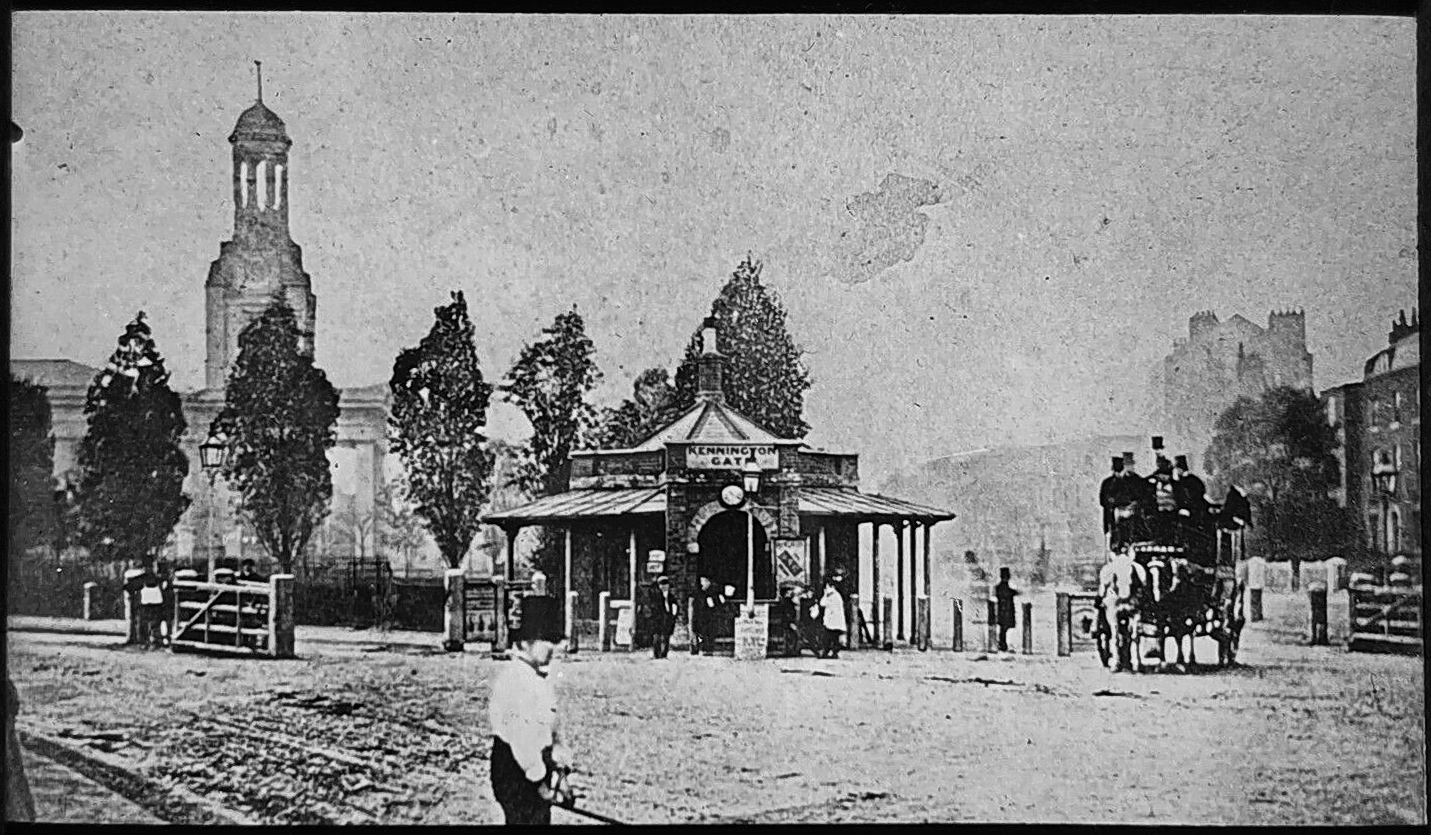
It is sad that the definition of the slide does not allow us to read any of the notices on the toll-gate below the ‘Kennington Gate’ sign in the building’s parapet [Fig.5]. It has to be said that the costumes in the photograph are more akin to fashions of the 1860s than the 1890s, so it is likely that Toms used an older photograph for his slide, and that this scene is in fact from thirty years before the date of the slide (1893/4). Indeed, an identical scene was reproduced as a wood-engraving in the Illustrated London News of December 1865, complete with the same two-horse coach (with identical horses) [Fig.6].
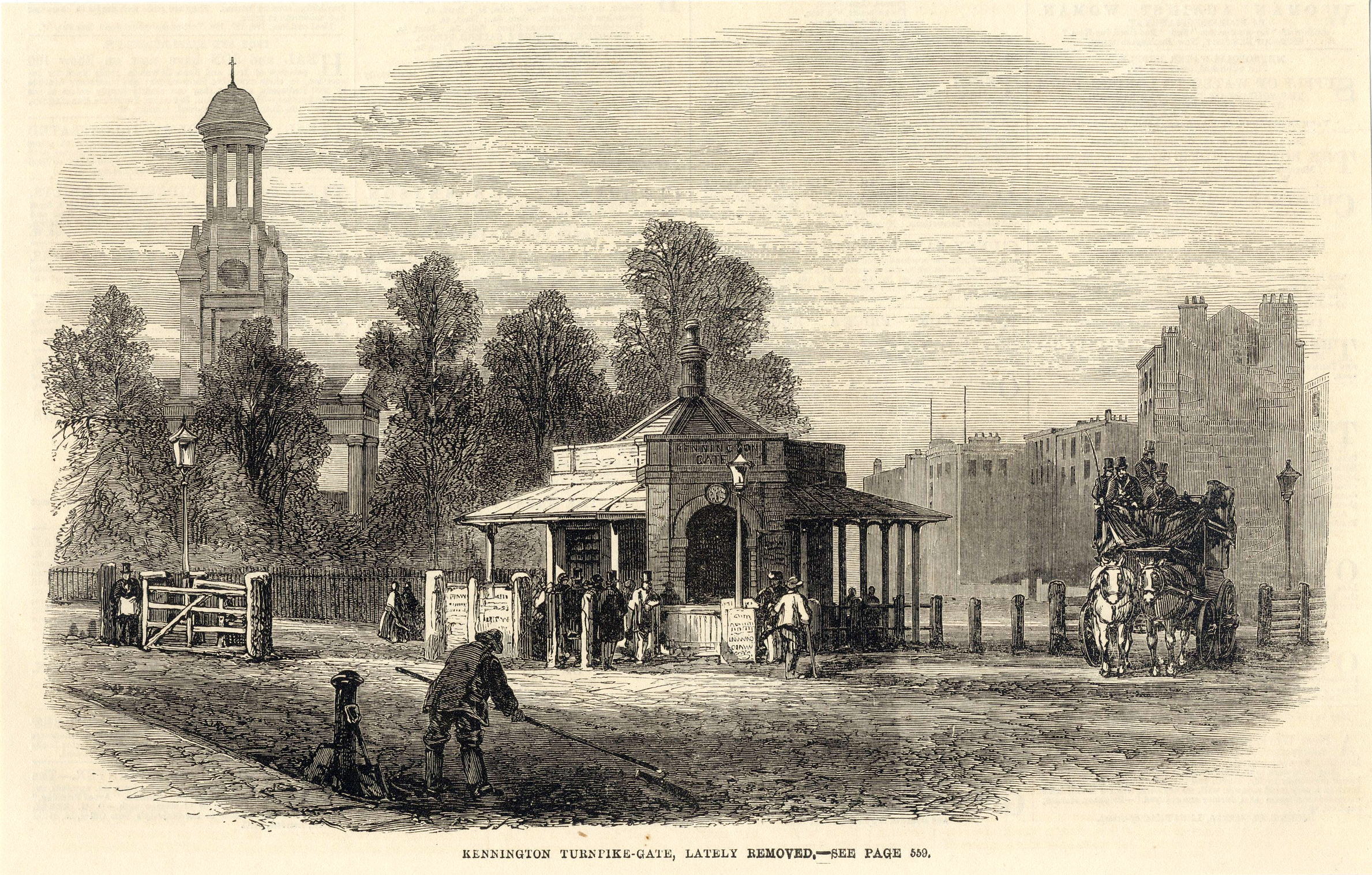
There are a few small differences between the two compositions, to be sure, but there are enough close similarities to make it probable that the engraver used the same image for his reference as Toms later used for his lantern-slide. The 1865 caption to the print tells us that the turnpike building had recently been ‘removed’, so by the time the slide was produced, the building would have been absent for almost thirty years. Toms is in fact selling not news but nostalgia.
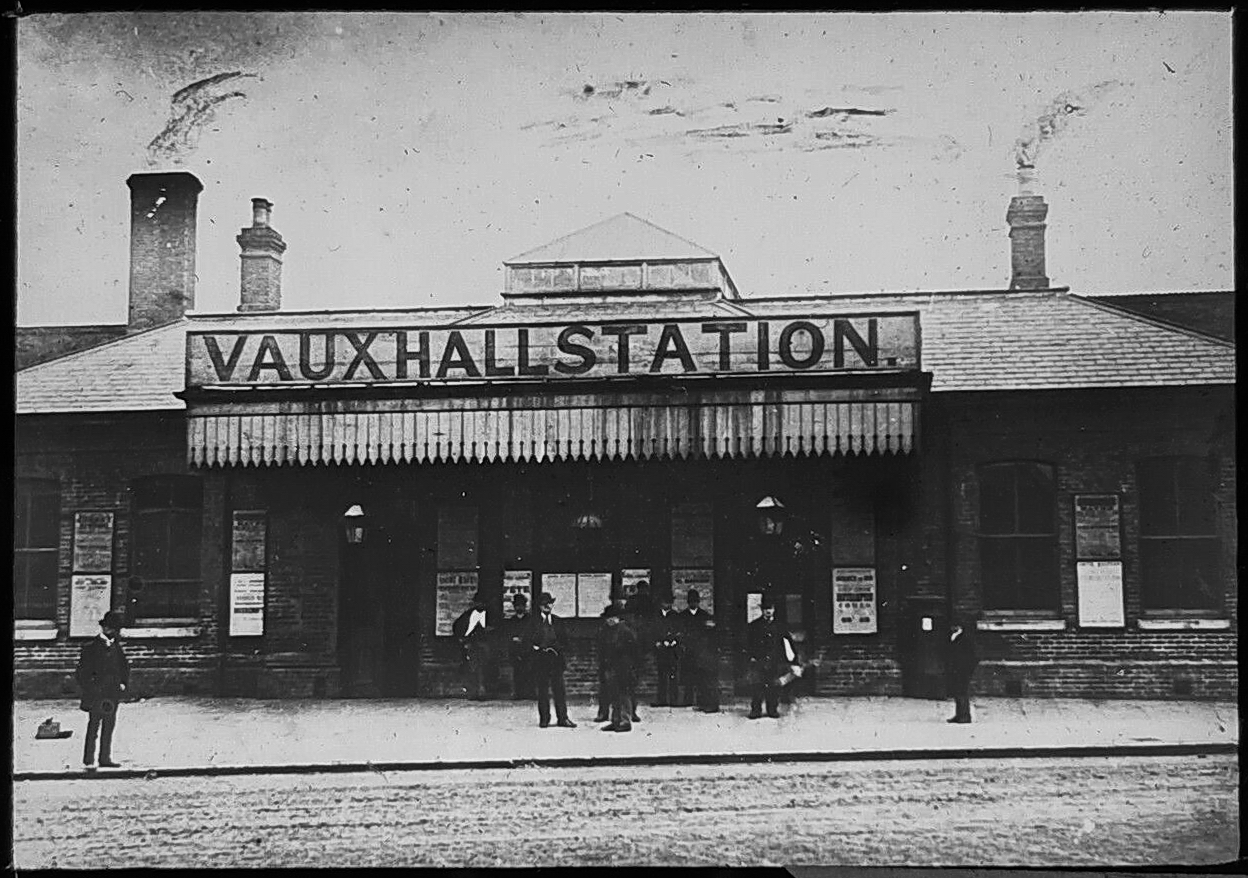
The painterly tone is lacking in the second slide – ‘Old Vauxhall Station’ (c.1893) is more matter-of-fact, although even here H.L. Toms has used an older original photograph to produce his slide [Fig.7]. The very fact that he titles it ‘Old Vauxhall Station’ suggests that it had been replaced by a new one, or had at least been heavily altered. The original timber building was called ‘Vauxhall Bridge Station’ when it opened in 1848. Its location was partly dictated by its proximity to Vauxhall Bridge, allowing access from north of the Thames, and to Vauxhall Gardens – still a popular attraction at that time. This original station, of which little record survives, was destroyed by fire on Sunday 13 April 1856, and had to be rebuilt from the ground up. The name of the new building was officially altered from Vauxhall Bridge Station to the simpler Vauxhall Station in 1863. It is likely that the photograph used by Toms dates from this time, and that his slide post-dates some major rebuilding or alteration. The fashions worn by the men around the station, especially their bowler hats, were not widespread before the 1860s.
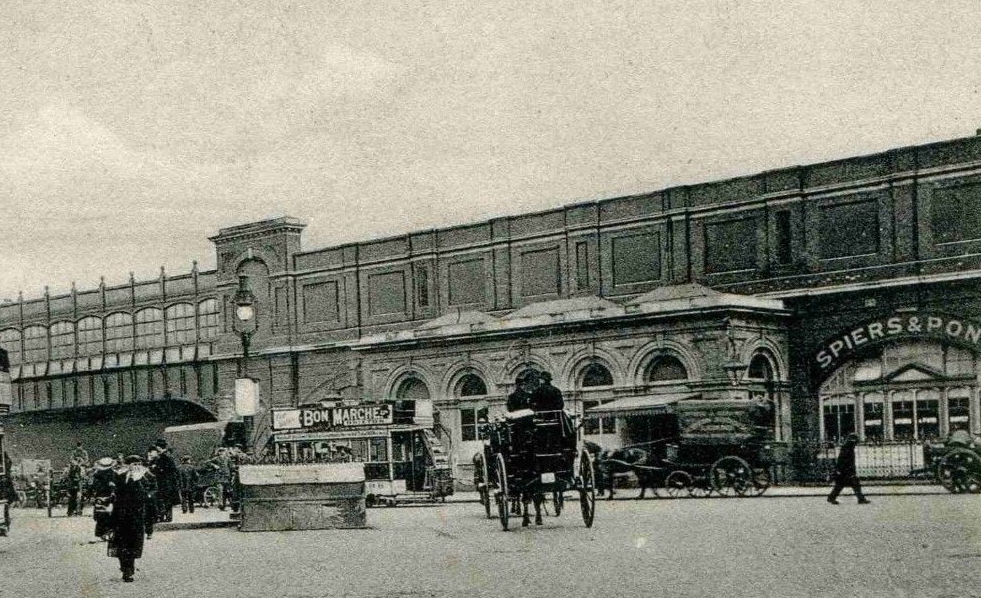
The station’s current exterior has existed since at least the start of the 20th century, as evidenced by postcards of the period [Fig.8], but the core of the building could be the same as in the Toms slide; add the five-arched white stone and brick frontage with its parapet around the roof, and the raised panelled wall on the railway viaduct above, and today’s building is apparent.
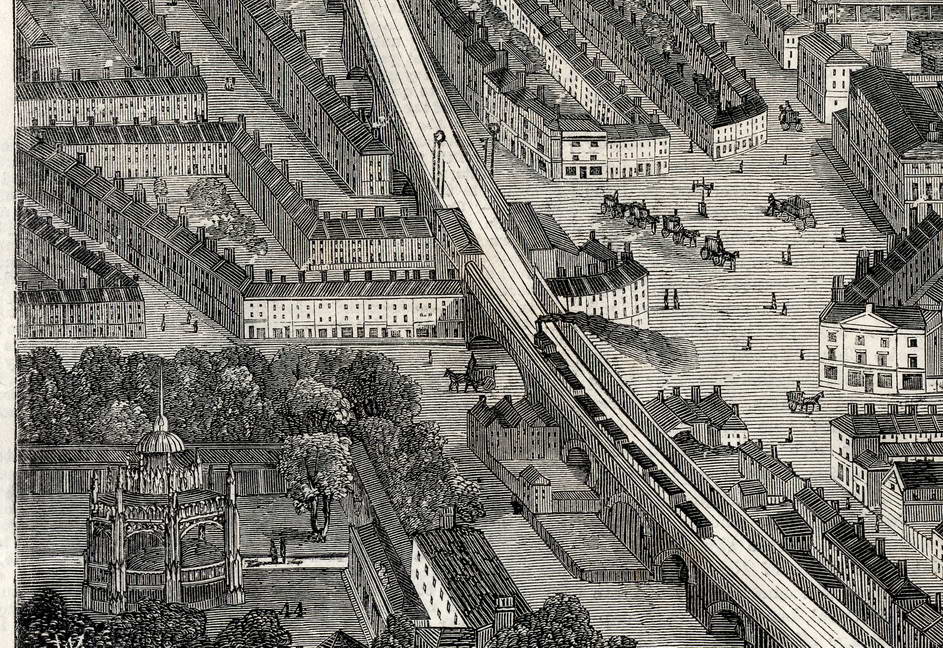
The only other visual document I am aware of that may show this building in the same state as in Toms’s slide is the large print called ‘The West End Railway District’ published by the Illustrated London News on 9 April 1859. A tiny detail of this aerial view shows a steam locomotive with goods trucks just pulling into Vauxhall Bridge Station [Fig.9]. The pitched roof on the right side of the railway is surely this same station building. A horse and cart to the right of the train is heading towards Vauxhall Bridge, and Vauxhall Gardens can be seen in the lower left corner.
As in the turnpike slide, there are several advertising handbills stuck on the station facade, most of which are illegible; however, one for Ascot Races and one for an event at Cowes, probably the Royal Regatta, stand out. These two major events in the English social calendar take place regularly in June and early August respectively. Between these two posters is another announcing a ‘FETE’, with an illustrated headpiece, probably advertising one of the anniversary Fetes mounted at the Surrey Zoological Gardens, in Walworth, to the north-east of Kennington Common, open between 1831 and 1877. All of these place the original photograph in the summertime, sometime between 1863 when the station’s name changed and 1877 when the Surrey Gardens closed.
This slide represents a scarce record of the appearance of Vauxhall Station between the 1856 re-build and the addition of the new arched facade, between 1889 and 1892, when major works were undertaken at the station to provide additional lines and platforms, and a new waiting room, on the viaduct [see Network Rail archive design].
The turnpike and the old station are just two of the familiar features of the Vauxhall landscape that have disappeared, neither probably much mourned, but both recognised landmarks in their time. The Toms slides allow us just a glimpse into a tiny corner of Vauxhall’s past, to rediscover something of how people lived at the time. We wait to see what will disappear from the Vauxhall townscape of our own times, and whether any of it will be missed.