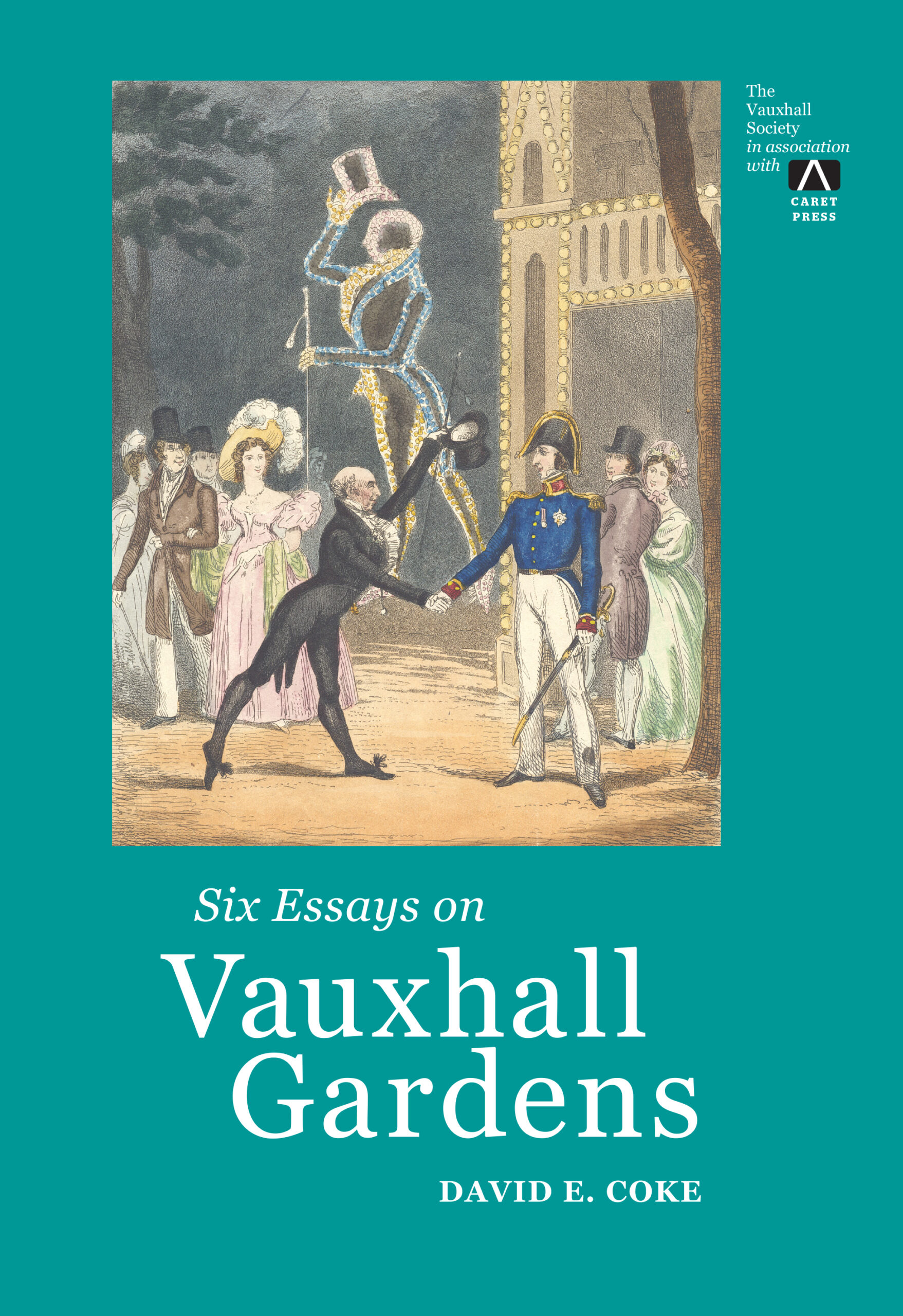

For historian (and VauxhallHistory.org consultant) David Coke at least, Vauxhall Gardens remains a place of endless appeal, fascination and entertainment, despite the fact that it closed almost 170 years ago. This appeal is partly because so many unexpected and surprising objects and stories emerge continually, each one enriching our knowledge of the place, and highlighting its magic and uniqueness. It is true that Vauxhall was only one of many such pleasure gardens in Georgian London, but there is so much about it that makes it special and enthralling.
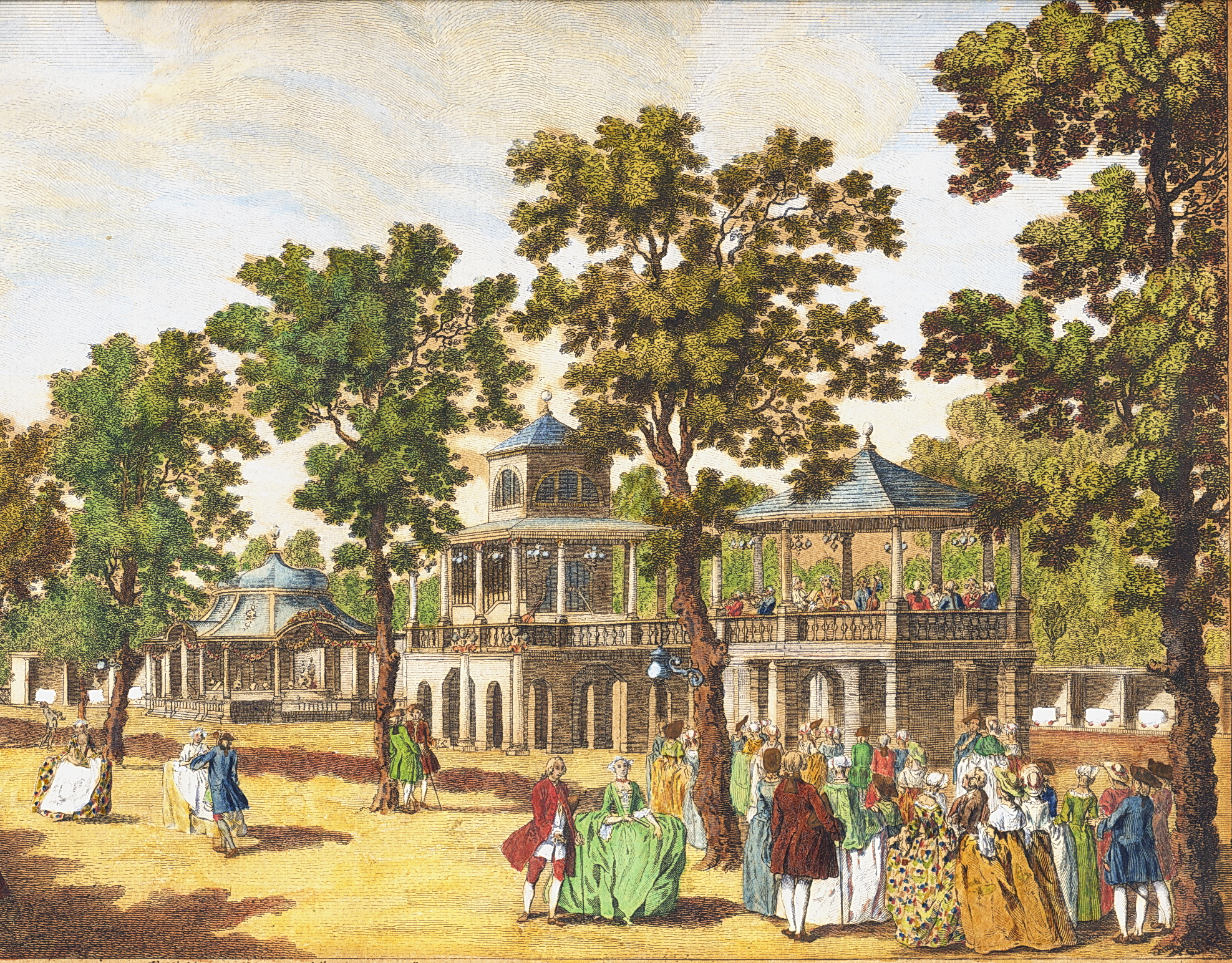
One of Vauxhall’s great attributes is the huge number of topographical and satirical prints that it generated, each one different and each one teaching us a little more about it. Outside the royal palaces, Vauxhall Gardens must have been one of the most profusely illustrated places in England in the Georgian period, demonstrating some of its popularity. In his time as proprietor, Jonathan Tyers the elder was careful to maintain a strict control on Vauxhall’s publicity and visual image [Fig.1], meaning that all his media coverage was, almost without exception, positive. After his death in 1767, this control began to slip; his son, also Jonathan, lacked his father’s ability or willingness to exert such heavy control, leading to an openness and honesty in the work of artists and journalists that reveals more reality about the garden than can be observed in earlier years. The satirists in particular had something of a field day with this fruitful site of social interaction.
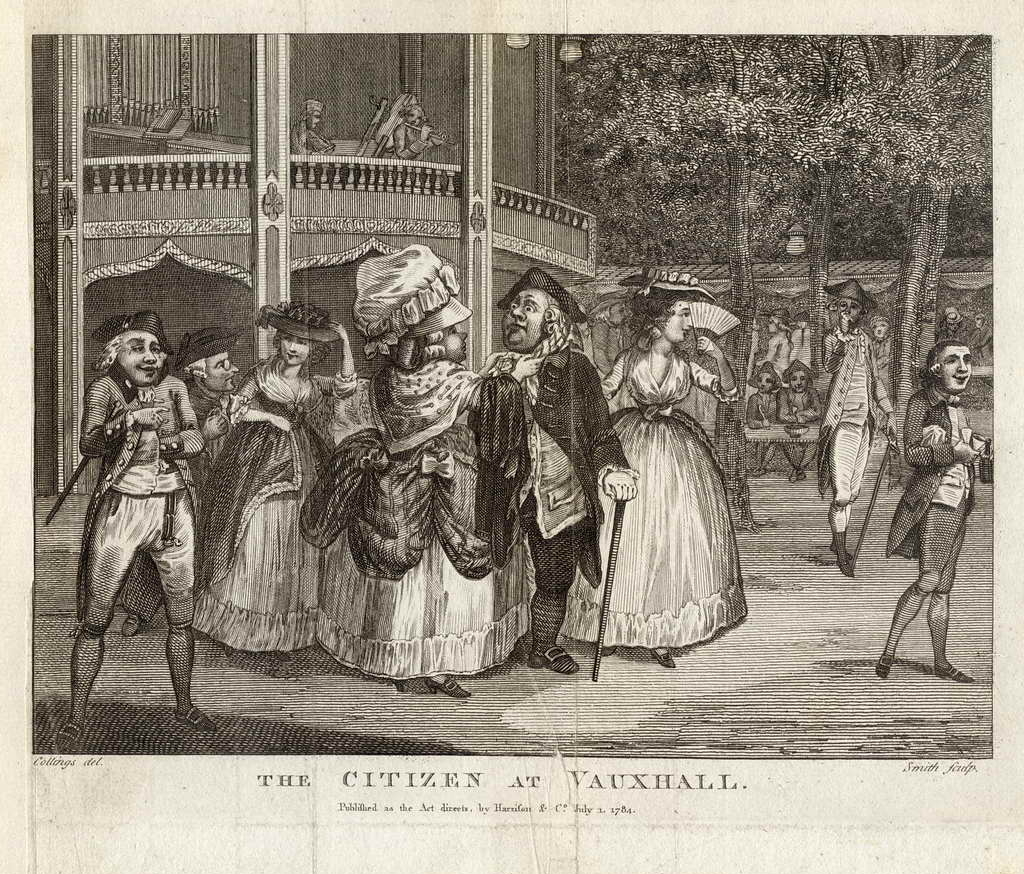
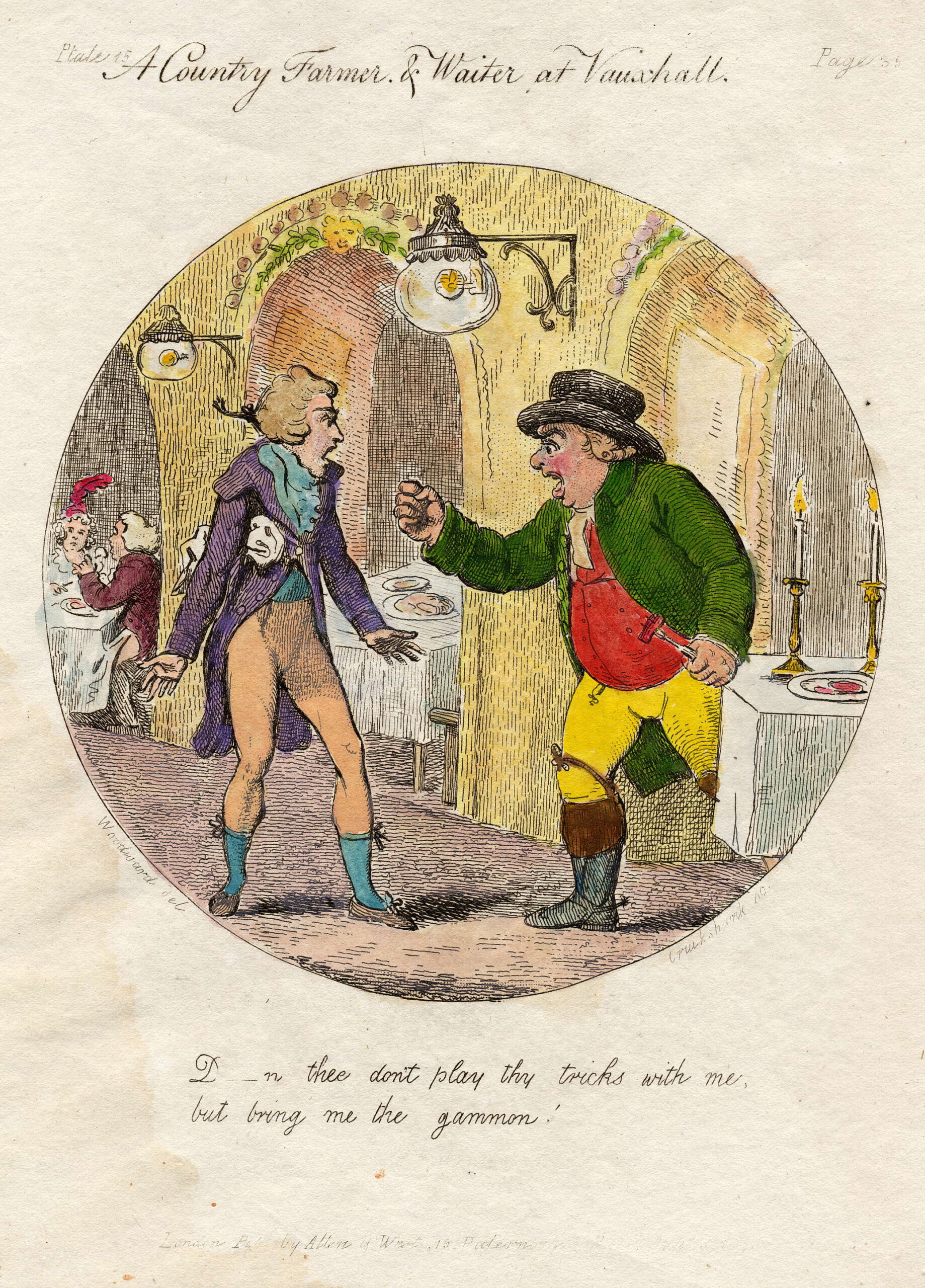
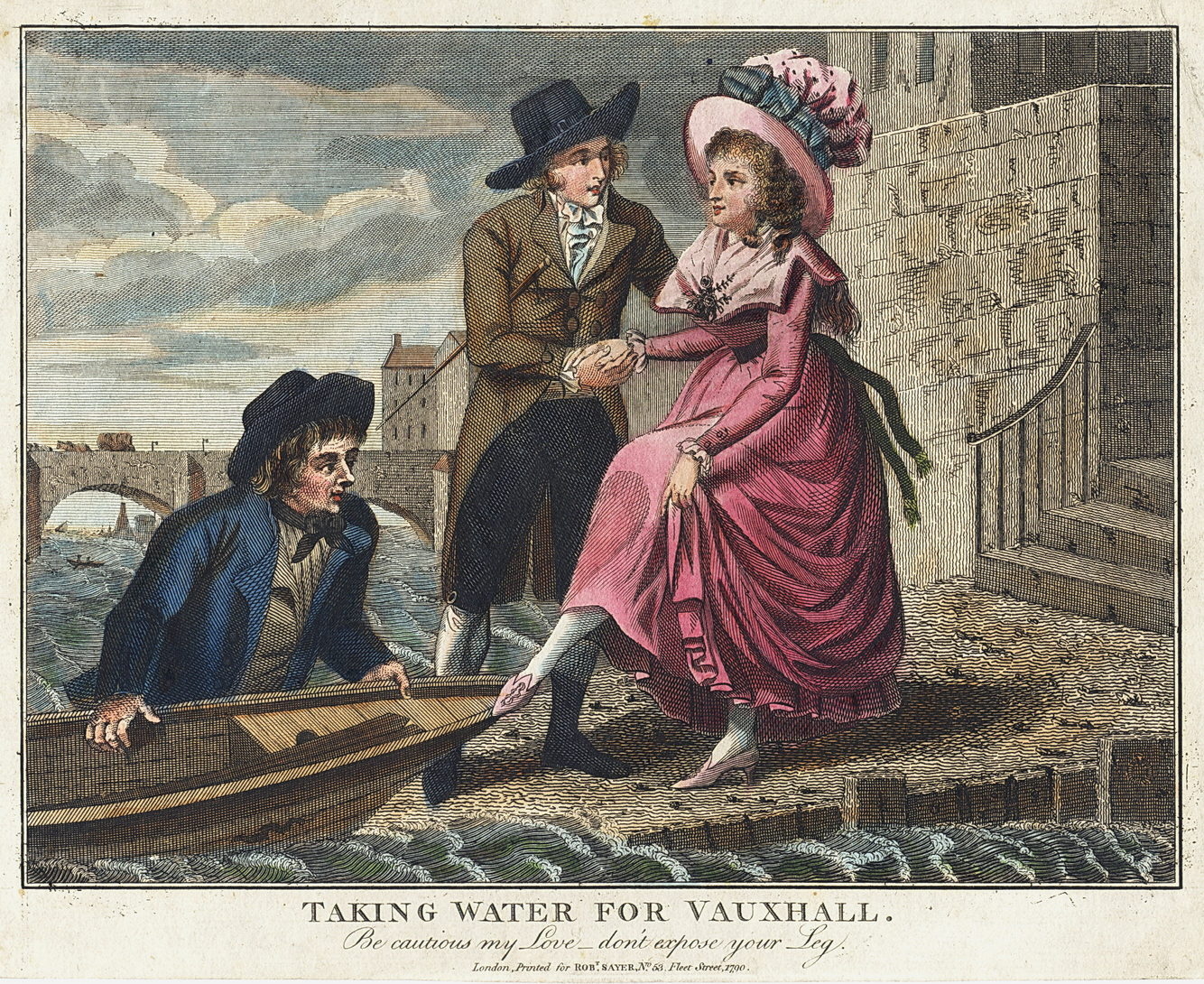
Neither ‘The Citizen at Vauxhall’ [Fig.2], nor ‘The Country Farmer and Waiter’ [Fig.3], each with their accompanying stories, nor even an image as harmless as ‘Taking Water for Vauxhall’ [Fig.4], would have seen the light of day under Jonathan Tyers Sr., yet they tell us more about his gardens and its visitors than all the elegant Canalettos put together.
A new discovery (for me anyway) fits in admirably with this trend, especially in its focus on Vauxhall’s less fashionable visitors rather than its fixed attractions. Jonathan Tyers would have been totally horrified not only by the way it makes fun of Vauxhall’s visitors and management, but also by the way it shows his precious pleasure garden as a place of discord and disorder, diametrically opposed to the image he worked so hard to promote.
This discovery was made on a recent visit to an old and dear friend who is almost as much of a Vauxhall fanatic as I am. Hanging on the wall in their house was a small framed print of Vauxhall I had never seen before, and did not know existed, even after almost fifty years of diligent research, and numerous visits to other collections worldwide.
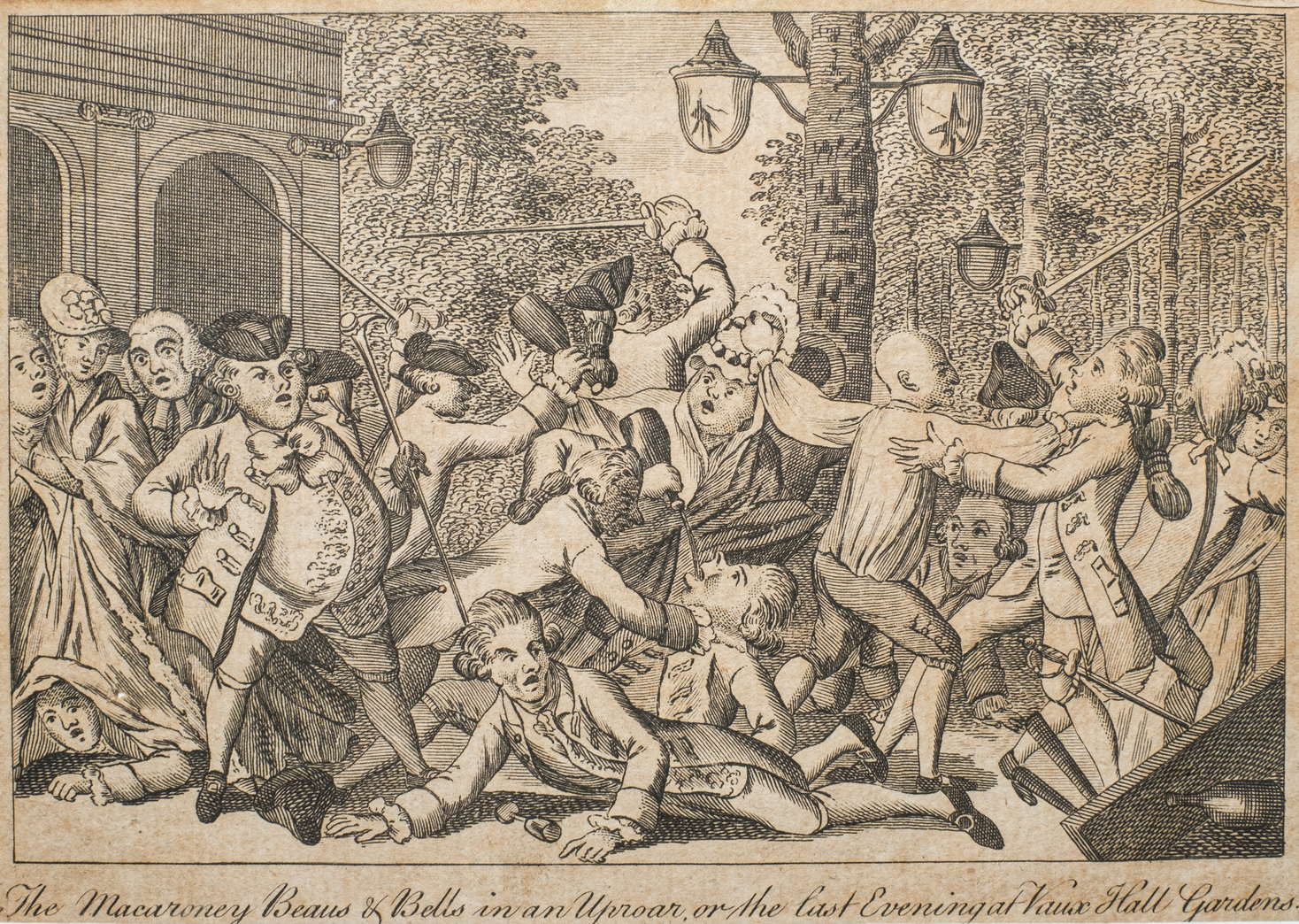
This anonymous print, entitled ‘Macaroney Beaus & Bells in an Uproar, or the last Evening at Vaux Hall Gardens’ [Fig.5] was first published in the Macaroni and Theatrical Magazine of September 1773 [p.529]. It is unique in depicting the ‘traditional’ riots on the last evening of the season at Vauxhall. It is known that these riots took place on a regular basis, and that the infrastructure of the Gardens, especially the lighting, took a serious battering each time. By the 1770s, most fashionable visitors knew that it would be a mistake to visit Vauxhall Gardens on the advertised ‘last night’ because they would be risking life and limb if they did. The Gazetteer of 1 September 1780 carried a report of that season’s ‘last evening’ when around 8,000 visitors attended, most of whom, however, were ‘of the middling, and inferior classes.’ It was regarded as a success that there was no riot until 3am, when ‘between thirty and forty lamps were broken by three blades, two of whom were a hair-dresser and an attorney’s clerk’ – definitely the inferior classes!
In the run-up to 1780 this last-night tradition had been well established, and was widely recognised (outside the Gardens) as a wonderful way of allowing exuberant youths to let off steam in their own way, so that such damage, seen as inevitable, would be limited to the Gardens. In its time, Vauxhall Gardens became a great boon to all sorts of retailers and tradesmen, partly because it helped to discourage the more wealthy and fashionable Londoners from retiring to their country seats for the summer months, but mostly due to its ability to help London’s youth let off steam, considerably increasing its value to London’s shopkeepers, taverns and markets. Some years later, there was a meeting of the ‘first-rate shopkeepers’ in the West End ‘to consider the justness of presenting to the Vauxhall Proprietors a splendid piece of Plate, as a mark of gratitude for the benefit the trading interest have derived generally, by so many of the nobility having been induced to remain in London, and continuing hourly to arrive, in consequence of the present popular and lengthened Season at those delightful Gardens.’[1]The Vauxhall Observer, 50, Friday 5 September 1823, pp.1–2.. This followed a summer of particularly unpleasant weather, which led into a finer autumn, inducing the proprietor to keep the Gardens open for another few weeks.
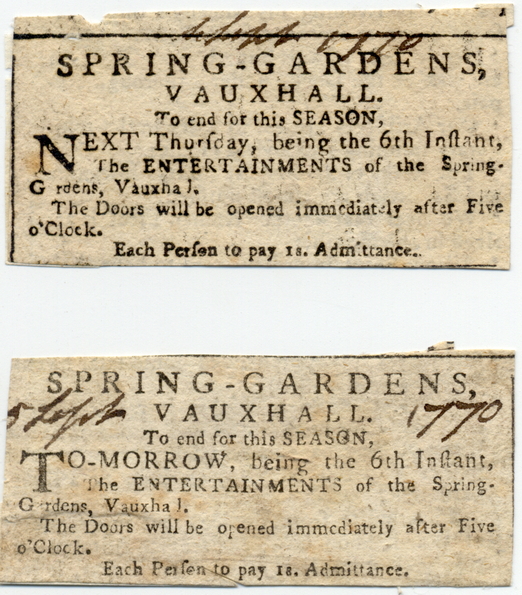
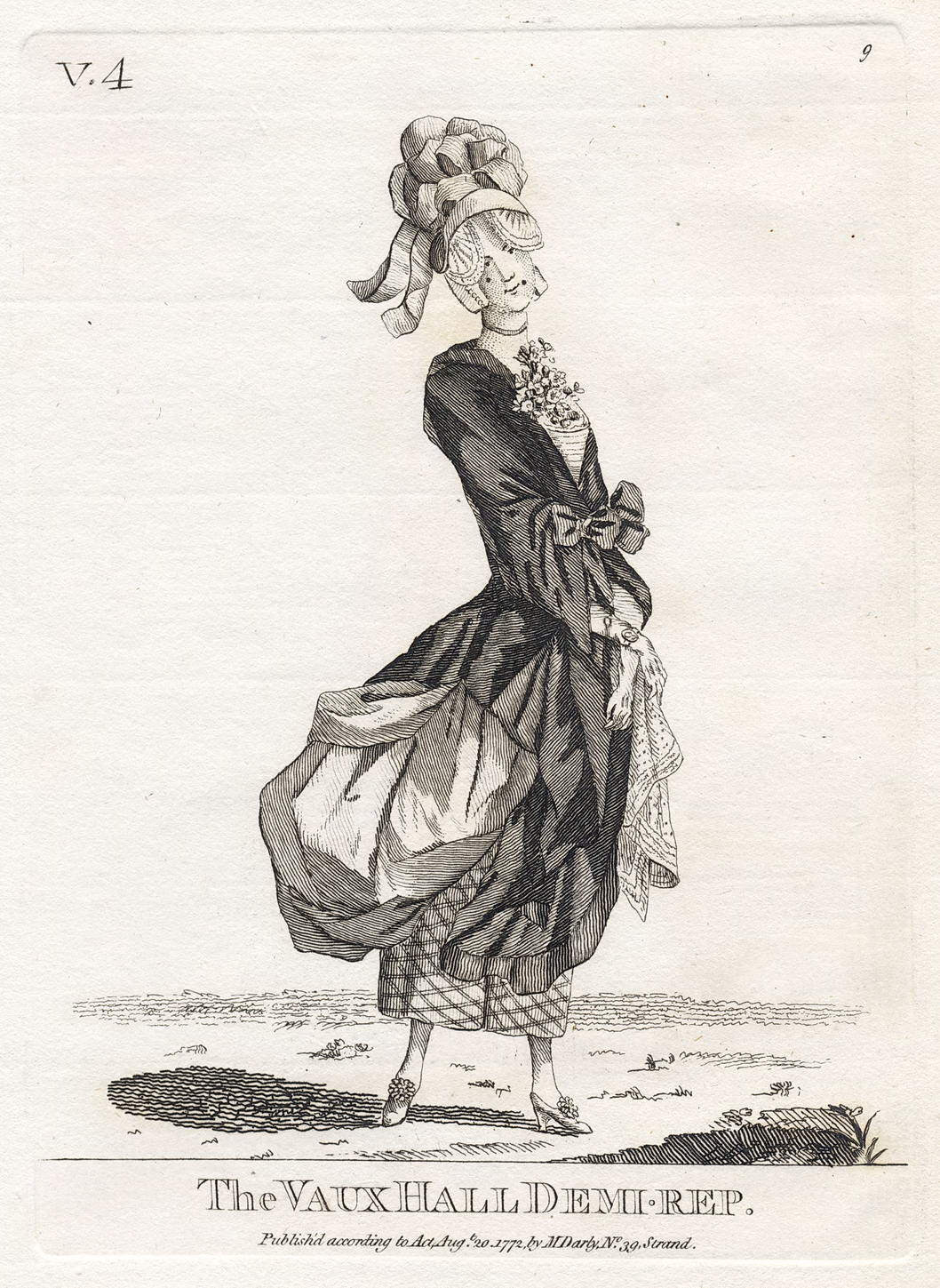
The weather of the 1773 season (when our print was published) was, apart from an exceptionally wet May, mainly dry, so the end of the season did not need to be extended into the autumn months; the scene depicted in the ‘Macaroney’ print [Fig. 5] must allude to an evening in late August or early September that year, when the Gardens usually closed for the season [Fig.6]. The trees are still in full leaf, and at least one man is in his shirt sleeves. The scene is one of total chaos in which swords have been drawn, several men have been knocked to the ground, and a large lady in the centre has been frightened out of her wits. Another female figure, at the extreme right, appears to be enjoying the rough-and-tumble, so she may be one of the women of the town who made Vauxhall their place of work, maybe one of the numerous ‘Demi-reps’ who would latch on to parties of young men to entertain them [Fig.7], earning money from tips. Another woman at the left side is taking advantage of the uproar to cling more closely to her chosen escort, while a cowardly chap keeps himself out of harm’s way concealed under her dress.
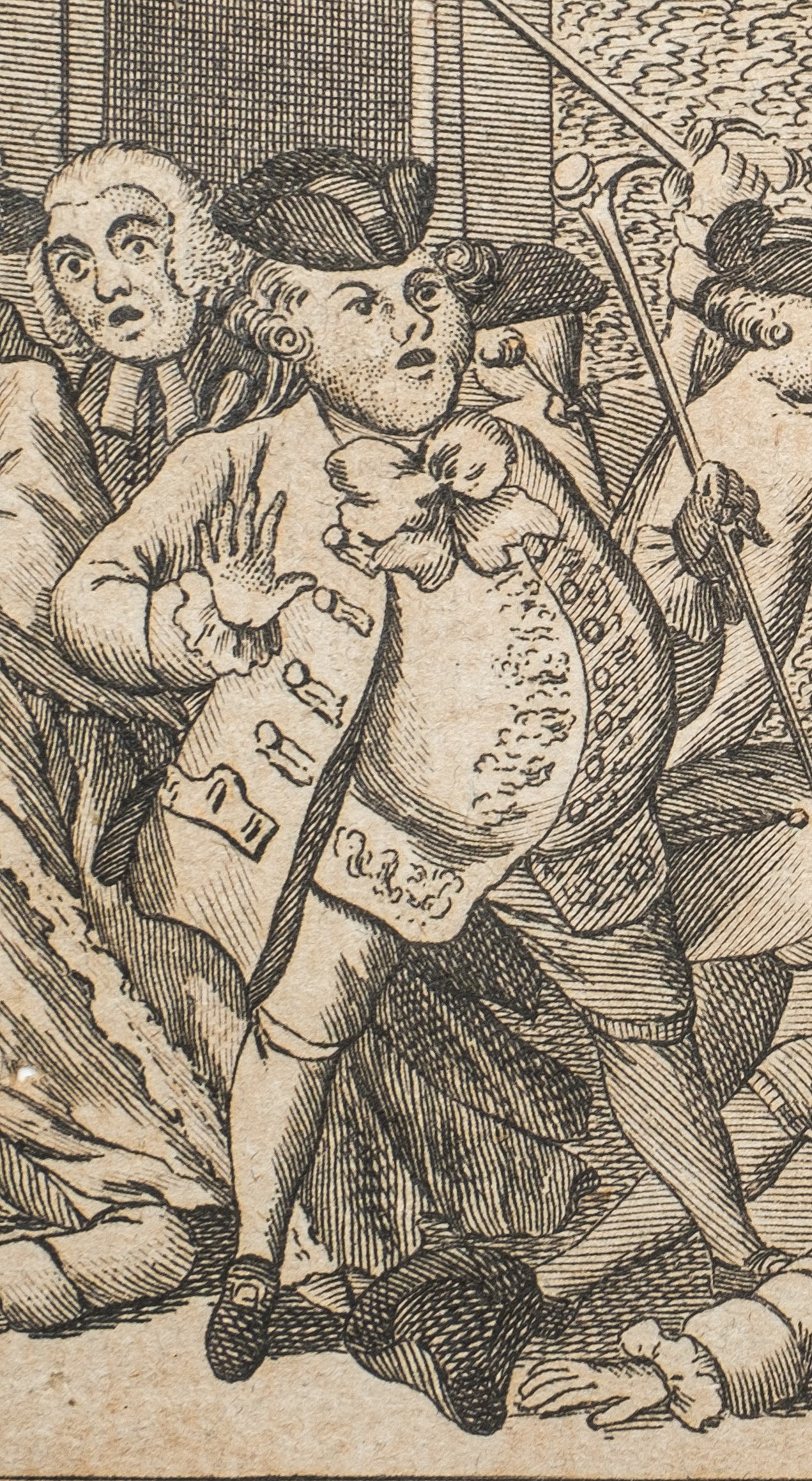
But the most noticeable figure in the print is not one of the rioters at all, but a rather portly figure, fashionably dressed and standing wide-legged like Henry VIII towards the left with his hands held up in horror at the sight before him [Fig. 8]. This must be Jonathan Tyers Jr. (1729–1792), the younger son of old Jonathan Tyers, and proprietor of the gardens since 1768, seeing all his season’s profits going up in smoke. The equally horrified cleric sheltering behind him must be one of the two chaplains regularly employed for the Vauxhall season, better-known for their greed than for their courage.
One of the swordsmen in the print is determinedly attacking a glass lamp fixed to a tree-trunk, on which another lamp has already suffered a terminal injury. An article about these riots in Bentley’s Miscellany (from which the quotes below are taken) notes that the last night of the season at that time was ‘always looked upon as a fit opportunity for the sparks of the time to let loose the full vigour of their pent-up mischief, which they accordingly did by wreaking their vengeance upon the lamps and other decorations – the waiters following and putting down the expense of their folly to the amount of the supper bill.’[2]Bentley’s Miscellany XXVIII. London: Richard Bentley, 1850, p.435.
Quoting from the Macaroni and Savoir Vivre Magazine of 1773, Bentley continues with a description of the same last night shown in the print – ‘About twelve o’clock at night the Macaronies began, as usual upon such occasions, to give proofs of their courage and magnanimity by venting their rage upon such harmless things as lamps, forms [benches, like the one in the lower right corner], bottles, and glasses, which cannot return the blow – slaying them most unmercifully.’ After carrying on their depredations in the Rotunda, they rushed out into the gardens again ‘seized the constable’s staff, and tossed it about to show their contempt for order’, the 18th-century equivalent of knocking off the policeman’s helmet.
‘Thus triumphant, and intoxicated with claret and success, one, more hardy than the rest, drew his sword and brandished it about, to the terror and amazement of the company; but, unfortunately for the Don Quixote, a certain gentleman who had contempt for such sport, and very little dread of such a weapon, closed with the hero, forced from him the tremendous blade, snapped it in two and held up the hilt, which produced a universal shout.’ The man in the shirt-sleeves may well be the undaunted character about to remove ‘Don Quixote’s’ sword and snap it in two. Another rioter then began to attack one of the ‘handmaids of Venus’, but he had underestimated his target, because she called her colleagues to assist and they attacked back, forcing the man into an undignified retreat. A vivid soundtrack to the fracas is supplied by a contemporary versifier:
‘To arms! to arms! the fierce virago cries,
And swift as lightning to the combat flies
All side in parties and begin the attack,
Canes rap, silks rustle, and stout-bottles crack,
Heros and heroines, shouts confusedly rise,
And base and treble voices strike the skies.’
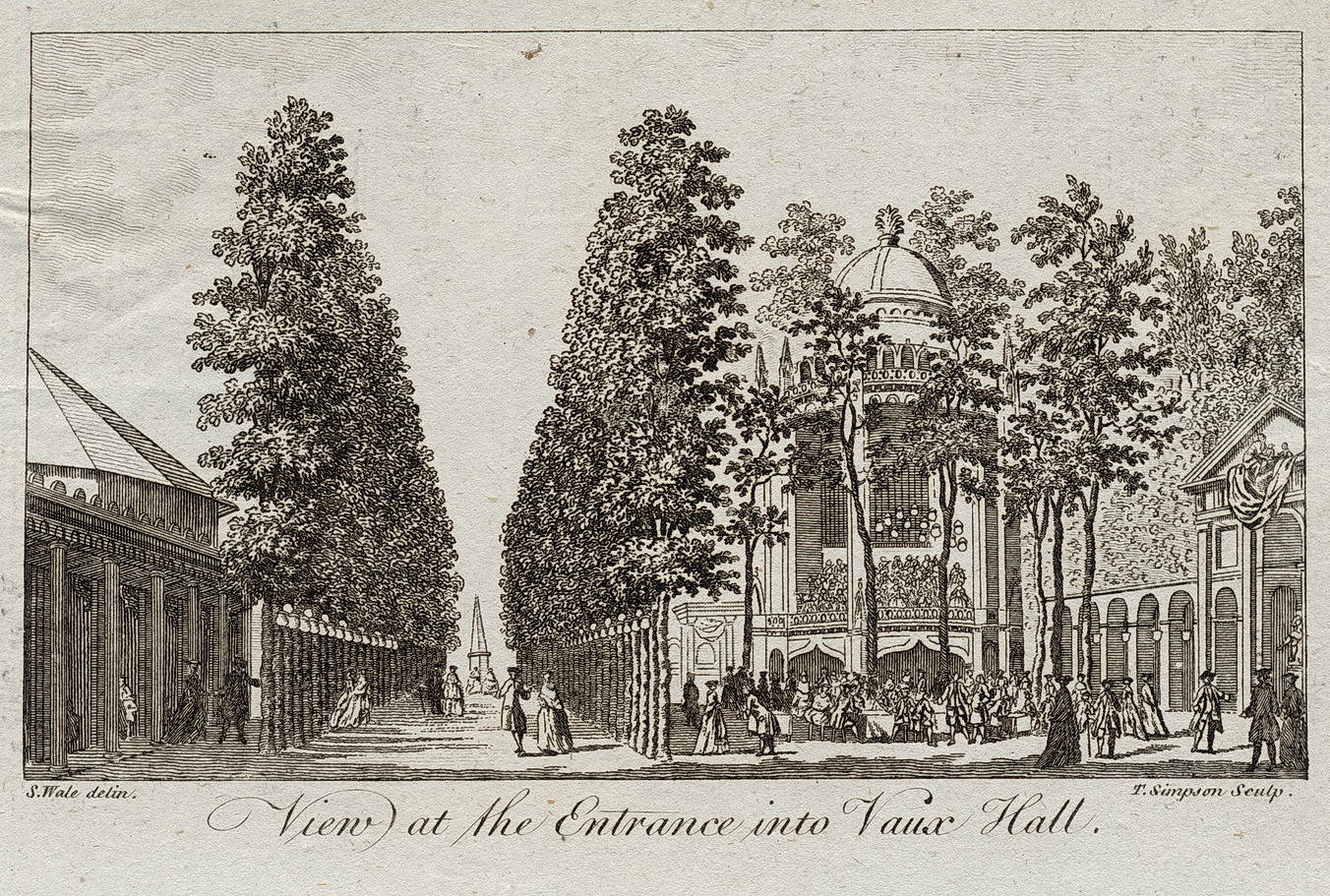
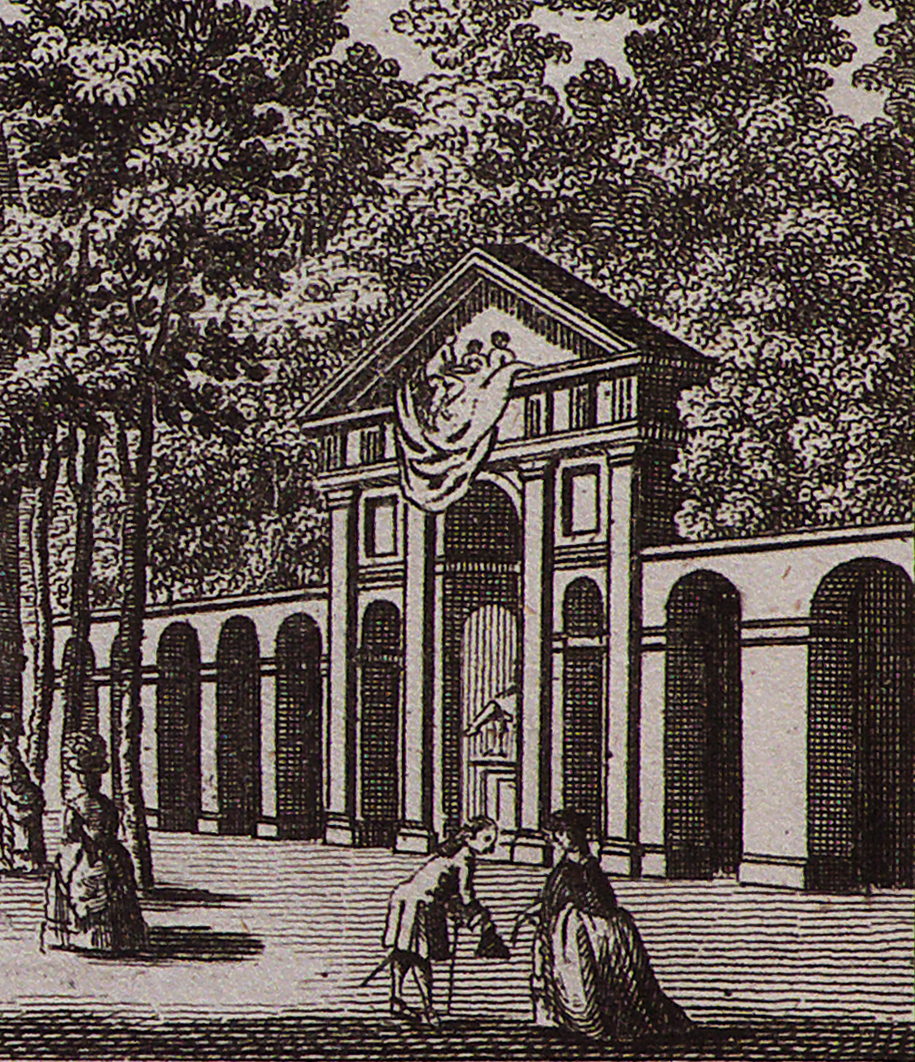
One odd feature of this print is the arched building on the left, which initially defied identification; however, it must represent a building seen only rarely in the topographical prints – the so-called Handel Portico, built c.1761 overlooking the Grand South Walk as a classical setting for Roubiliac’s famous statue of the composer George Frederick Handel, Vauxhall’s first musical director [Fig.9 & 10]; this portico was demolished before 1786, but fits well with the date of the print (1773). Jonathan Tyers’s dramatic gestures in the print are entirely understandable if this was indeed the setting for the violence – this part of the gardens housed not only the Handel statue but also many of the supper-box paintings by William Hogarth and Francis Hayman, all seriously vulnerable to damage from unthinking vandalism.
Because of the dangers of these riots, and the costs of repairing the damage, the proprietor let it be known that he would in future make every effort to ‘check the inordinate sallies of his patrons’; the next year he employed more ‘peace officers’ or constables in the hope that they could police the last evening; this tactic was advertised in the newspapers of the time. So, in 1774, ‘Thursday evening being advertised for the last of the entertainments at Vauxhall this season, the gardens were crowded with company. Everything went off with the usual regularity till about eleven o’clock, when divers persons begun to say that the proprietor’s advertisements, inserted in the newspapers of the day, were a challenge to the public, and their introducing peace-officers an insult to the company. Upon this a terrible riot ensued, a great number of lamps were broke, many constables soundly drubbed; and several women heartily frightened. About six o’clock in the morning the tumult began to subside, this gave the routed forces of the police courage to rally, which they did with such success that the enemy were dispersed almost in the twinkling, and sixteen of their leaders taken prisoners, who were immediately conducted to the house of correction.’
So, seven hours of drunken vandalism!
The following year (1775), the proprietor warned the potential vandals that the full weight of the law would descend upon anybody who took part in the traditional last-night riots. He also proposed to increase further the number of police officers at the event, in order to ‘prevent any future interruption to the amusements of the ever generous and indulgent public, whose countenance and protection they will always endeavour to deserve.’ Sadly, the ‘pent-up mischief’ of youth once again proved too powerful for the forces of order to control. And the damage was not limited to property – one of the rioters, ‘a good-looking, gentlemanly young man, supposed to belong to the noted Mr. M––––’s gang, was examined, charged with robbing a gentleman of twelve guineas.’
In 1776, therefore, the police, determined to put an end to the riots, reported that ‘near twenty young bucks, who were apprehended in Vauxhall Gardens on Thursday night, for breaking the lamps, were examined before the magistrates at the Rotation Office in the Borough, [in Southwark, where the magistrates attended in rotation] when such of them as could not make satisfaction for the mischief done [in other words, pay for the repairs], were ordered to find bail, or be committed, in order to take their trial at the next general quarter sessions.’
While a night in the cells could be easily explained away, it was precisely this sort of legal action in custody and then in the courts that the vandals did their very best to avoid, knowing that, if their friends and families came to hear of it, it ‘would be their ruin’. This particular ‘last night’ fell on 27 August 1776, and was reported in the Morning Post on the following day. Of the four thousand visitors on this occasion there were ‘very few there but commoners’. ‘Order was tolerably kept until twelve, only the apprehending of one pickpocket.’ The proprietor that day had devised a new strategy to defeat the disorder – he held back on the refreshments, especially the alcoholic ones, leading to many visitors having ‘to seek abroad for a supper’, and once out of the Gardens, they stayed out. After 1780, although the usual last nights are often the subject of newspaper reports, the riots appear to have become a thing of the past.
By this time, though, Vauxhall’s last night of the season had become so fixed in the popular imagination that it made its appearance in a contemporary novel. Young Branghton in Fanny Burney’s 1778 novel Evelina, who was characterised as something of a young ‘blade’, encouraged everybody to stay in London until Vauxhall’s last night, as it was the best night of the year. ‘There’s always a riot, – and there the folks run about, – and then there’s such a squealing and squalling! and, there, all the lamps are broke, – and the women run skimper scamper. – I declare I would not take five guineas to miss the last night!’[3]Frances Burney, Evelina, Vol. II, letter XLVI, 17 June, London. T. Lowndes, 1778.
One significant aspect of this print, its caption, is worth looking at in more detail. The title begins ‘The Macaroney Beaus and Bells’, alluding to the fashions of the time. Macaronis were so-called because of their almost Italianate attention to extravagant and modish dress, the continental and effeminate affections in their behaviour and speech, and their general excess in care of themselves and their appearance. They had their own magazine, The Macaroni and Savoir Vivre Magazine, ‘savoir vivre’ meaning a knowledge of how to live most elegantly and with refinement. They also had their own gentleman’s club, the Savoir Vivre Club, founded in 1773 at the Star and Garter Inn on Pall Mall. The club eventually merged with Boodle’s, still extant on St James’s Street today.
Macaronis were seen as ridiculous by the general public, and were much satirised by artists and writers. Even the Italians themselves made fun of them; in the same year as the publication of the print, an English tourist visited the opera in Palermo, Sicily, where he saw a balletic depiction of Vauxhall Gardens, in which the Gardens were well represented, probably from engravings of the time. The ballet satirised the English macaroni fashions, which the traveller hoped would ‘have its effect, by shewing the fops of the present day how contemptible they make themselves appear in the eyes of foreign nations.’[4]Gentleman’s Magazine, XLIII 1773, p.479–80; a letter from Patrick Brydone FRS, to William Beckford.
In the ballet, ‘A variety of good English figures are brought in: some with large frizzled wigs sticking half a yard out behind their necks; some with little cut scratches, that look extremely ridiculous. Some come in cracking their whips, with buckskin breeches and jockey caps. Some are armed with great oaken sticks; their hair tied up in enormous clubs, and stocks that swell their necks to double the natural size.’[5]P. Brydone, A Tour through Sicily and Malta in a Series of Letters to William Beckford, Esq. of Somerley in Suffolk, from P. Brydone, F.R.S. Dublin: Marchbank, 1780, p.218, in a letter of 28 July … Continue reading
The ‘Macaroney Beaus and Bells’ phrase of the title has been purposefully mis-anglicised in order to highlight the pitiful insularity of these particular youths, who have managed to espouse the Macaroni style only very half-heartedly. Indeed, the ‘Macaroney Beaus and Bells’ print shows nothing of the ‘correct’ extravagances of costume, although the florid man in the centre emptying a wine bottle down his friend’s throat does sport a looped ‘club’ on his wig, as does the swordsman on the right; the term ‘macaroni’ in this instance appears simply to act as a generic term for the well-off youth of the time, who, like the youth of many other eras, made trouble for the forces of order and decorum. However, an anonymous poem published in the same year (1773) does suggest that the average Vauxhall visitor of the time was maybe a little less refined than they had been under old Jonathan Tyers:
Such is Vauxhall –
For certain every knave that’s willing,
May get admittance for a shilling;
And since Dan Tyers doth none prohibit,
But rather seems to strip each gibbet,
His clean-swept, dirty, boxing place,
There is no wonder that the thief
Comes here to steal a handkerchief;
For had you, Tyers, each jail ransacked,
Or issued an insolvent act,
Inviting debtors, lords, and thieves, –
To sup beneath your smoke-dried leaves, –
And then each knave to kindly cram
With fusty chickens, tarts, and ham, –
You had not made such a collection,
For your disgrace and my selection.[6]thebookofdays.com/months/may/28.htm accessed 30-03-2026.
‘Dan’ in this verse is not a Christian name, but it denotes the senior person present, referring of course to Jonathan Tyers the younger, aged just forty-four at the time, and clearly not as fussy as his father was about who he admitted to the gardens. From his appearance in the print [see Fig. 8], with the large bow at his neck, his tiny tricorn hat, and his immaculate dress, it looks as though (despite his age) he identified as one of the Macaronis himself, so he may have been unwilling to exclude his imagined peers, willing to put up with the trouble they brought with them. In his younger days, Jonathan Jr. had been sent to sea with the East India Company by his father to induce him to forget an unsuitable bride; this led to a serious rift in the family, and probably induced the son to rebel against his father in any way he could. In any case, still against his father’s wishes, he married his sweetheart, who had been married and widowed in his absence.
In conclusion then, this extraordinary, scarce and fascinating print takes as its subject the eternal rebelliousness of youth against authority, whether in behaviour, in dress, in hairstyle, in vocabulary, or simply in doing things differently. But by including some of the older generation, especially Jonathan Tyers Jr. and his chaplain, the anonymous artist makes the point that the more things change, the more they remain the same, and, no matter how hard they rebel, today’s vandals necessarily become tomorrow’s entrepreneurs and professional men, to exert their own authority on the following generations. All quite as relevant in the 21st century as in 1773.
David Coke
June 2026
References
| ↑1 | The Vauxhall Observer, 50, Friday 5 September 1823, pp.1–2. |
|---|---|
| ↑2 | Bentley’s Miscellany XXVIII. London: Richard Bentley, 1850, p.435. |
| ↑3 | Frances Burney, Evelina, Vol. II, letter XLVI, 17 June, London. T. Lowndes, 1778. |
| ↑4 | Gentleman’s Magazine, XLIII 1773, p.479–80; a letter from Patrick Brydone FRS, to William Beckford. |
| ↑5 | P. Brydone, A Tour through Sicily and Malta in a Series of Letters to William Beckford, Esq. of Somerley in Suffolk, from P. Brydone, F.R.S. Dublin: Marchbank, 1780, p.218, in a letter of 28 July 1773. |
| ↑6 | thebookofdays.com/months/may/28.htm accessed 30-03-2026. |